Tag: SDD

  • What’s really coming out of my XRD tube?

    What’s really coming out of my XRD tube?

    We’ve been experimenting with better ways to quantify the quality of XRD tubes in the shop. We use these tests on new and used tubes to monitor performance in two key areas. 1) Intensity 2) Spectral purity.

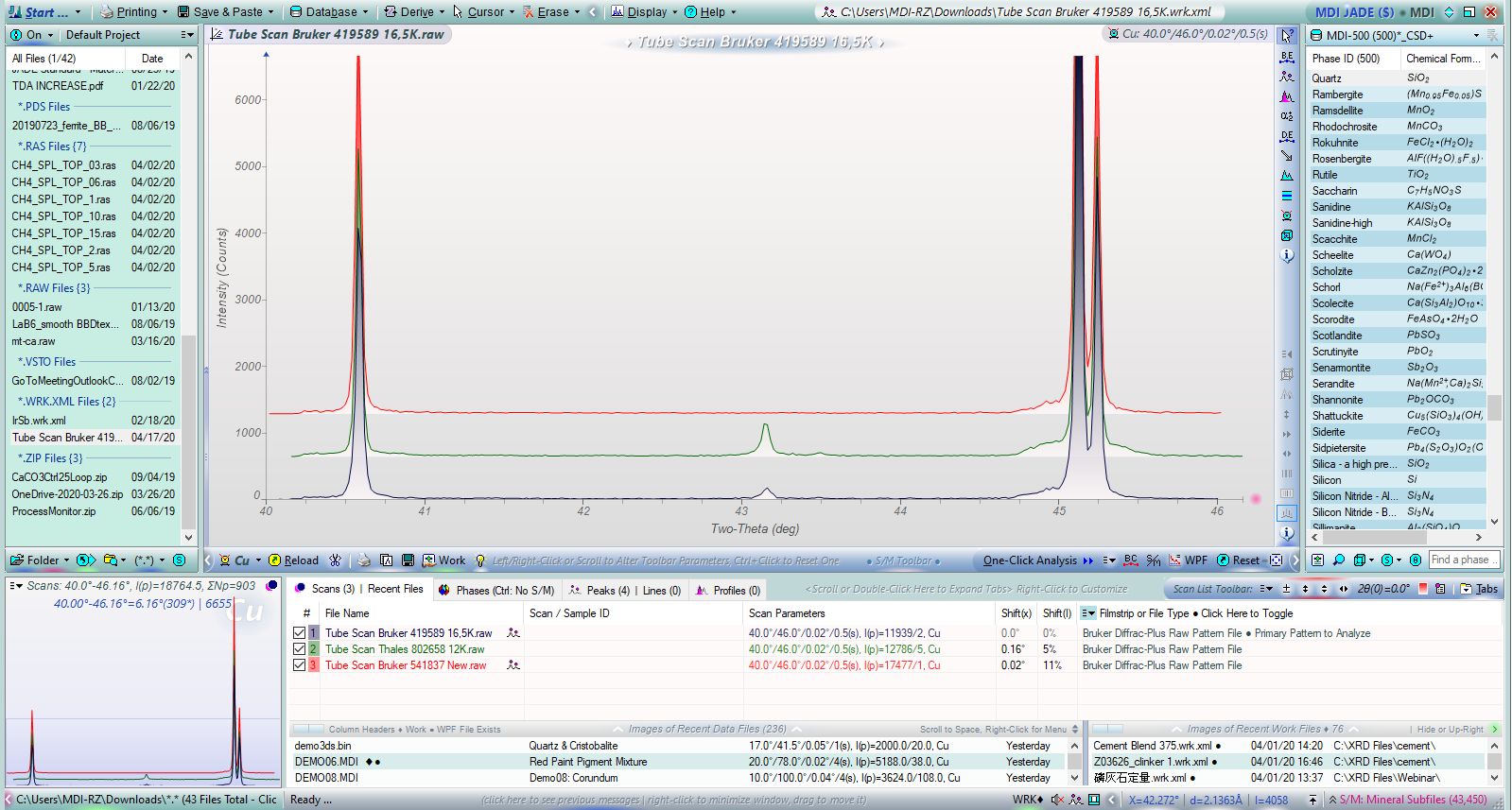
    What we’ve settled on is a test that involves a wavelength-dispersive approach which gives us a lot of intensity to work with while eliminating background scatter and fluorescence effects. Basically, we’re able to extract more information from the data because the “noise” is almost zero.

    We used Jade Pro to evaluate the scans, but they’re not D-spacing vs intensity as one would normally expect. This scan represents Wavelength vs intensity more like one would see in a WDXRF spectrometer. Cu KA1 and 2 are obvious, as is Cu KB1. Many of the current generation of XRD users have never seen a W LA1 peak in their data, but it’s clearly visible here as this is an older tube. What I’ve never been able to see before is the W La2 peak in the green scan. You’re looking at a peak that is ~62eV separated from W La1. No XRD detector on the market has energy resolution like that so these would always be lumped together so you’d see a series of additional peaks from every d-spacing in the sample in the diffractogram. Only a handful of detectors (our SDD-150 for example) could even separate the W La from the Cu K lines. That’s the power of wavelength-dispersive techniques. Incidentally, the most common device for cleaning up superfluous energy emissions in XRD data is a diffracted-beam monochromator and they eliminate all the W La through a secondary diffraction event much like what we’re doing.

    Characterizing emissions is nothing new. In fact, I started wanting to improve this after listening to a talk at DXC about Jim Cline’s famous XRD system which is used at NIST to perform the primary data collection on the CRMs we all use. To paraphrase Sir Arthur Conan Doyle, “When you explain every extraneous data point, the remaining information is the pure truth of the sample”.
  • Energy-dispersive detector systems for XRD applications

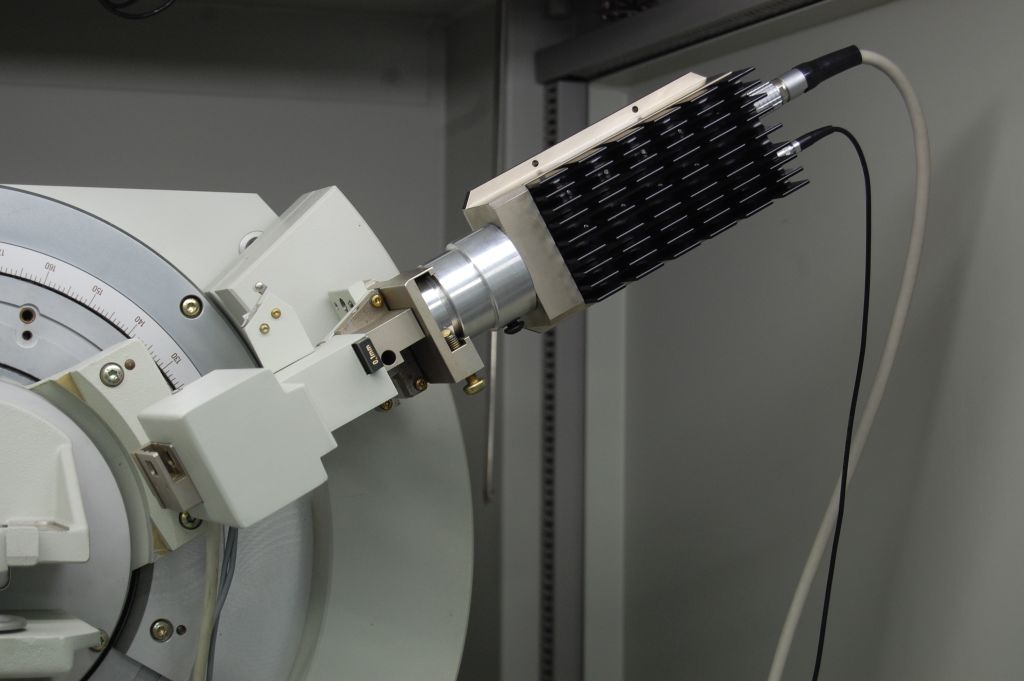
    Energy-dispersive detector systems for XRD applications

    Energy resolution

    • 140eV under ideal conditions.
    • All KB peaks eliminated electronically.
    • W LA1 (8.40 KeV) lines eliminated from Cu KA1,2 (8.04 KeV) scans even with thoroughly contaminated tubes.
    • Common fluorescence energies (i.e. Fe when Cu tube anodes are used) are greatly reduced. (Brehmstralung effects are impossible to remove completely)
    • Most PSD detectors offer no better than 650eV. This allows for a great deal of fluorescence energy to pass as well as W LA1 from older Cu tubes.

    Low angle scatter

    • The detector mounts in place of the traditional scintillation counter allowing for use of automated variable (motorized) or interchangeable aperture slits to control angular resolution. Scans starting from 0.5 degrees 2? are possible with the proper slit arrangement just as they are with the scintillation counter. The user controls the intensity vs angular resolution of the scan based upon the ideal conditions for their work rather than the limitations of the hardware.
    • Position sensitive detectors are wide open by design which necessitates knife edges over the sample and additional mechanical aperture plates to block air scatter at low angles. Closing off the detector limits the useable channels and reduces the benefit of these detectors dramatically.

    Truly zero maintenance design

    • No delays – The detector is ready to collect data almost as soon as power is applied.
    • No external cooling – Air backed Peltier cooling eliminates the need for water circulation and/or liquid nitrogen.
    • Zero maintenance vacuum design eliminates reliance on an ion pump/backup battery.
    • 12-month warranty against hardware failure under normal use.

    Versatility

    • The Digital Pulse Processor (DPP) includes a usb interface allowing for adjustment and refinement should they be necessary for a particular application. With optional software, full quantitative EDXRF analysis can be performed.

    The detector can be set for any common XRD anode (energy) easily. Multiple energies may even be configured to allow for use with various anodes without the need for additional hardware. We specialize in Siemens (now Bruker) XRD and WD-XRF instrumentation and have installation kits ready for the D500, D5000 and D5005. The output is a standard BNC cable with a 5V square pulse output which is standard across every manufacturer we’ve worked with. Kevex and Thermo Si(Li) detectors used this same output.

    Please contact KS Analytical Systems for a quote.